UFO on Llangorse Lake!
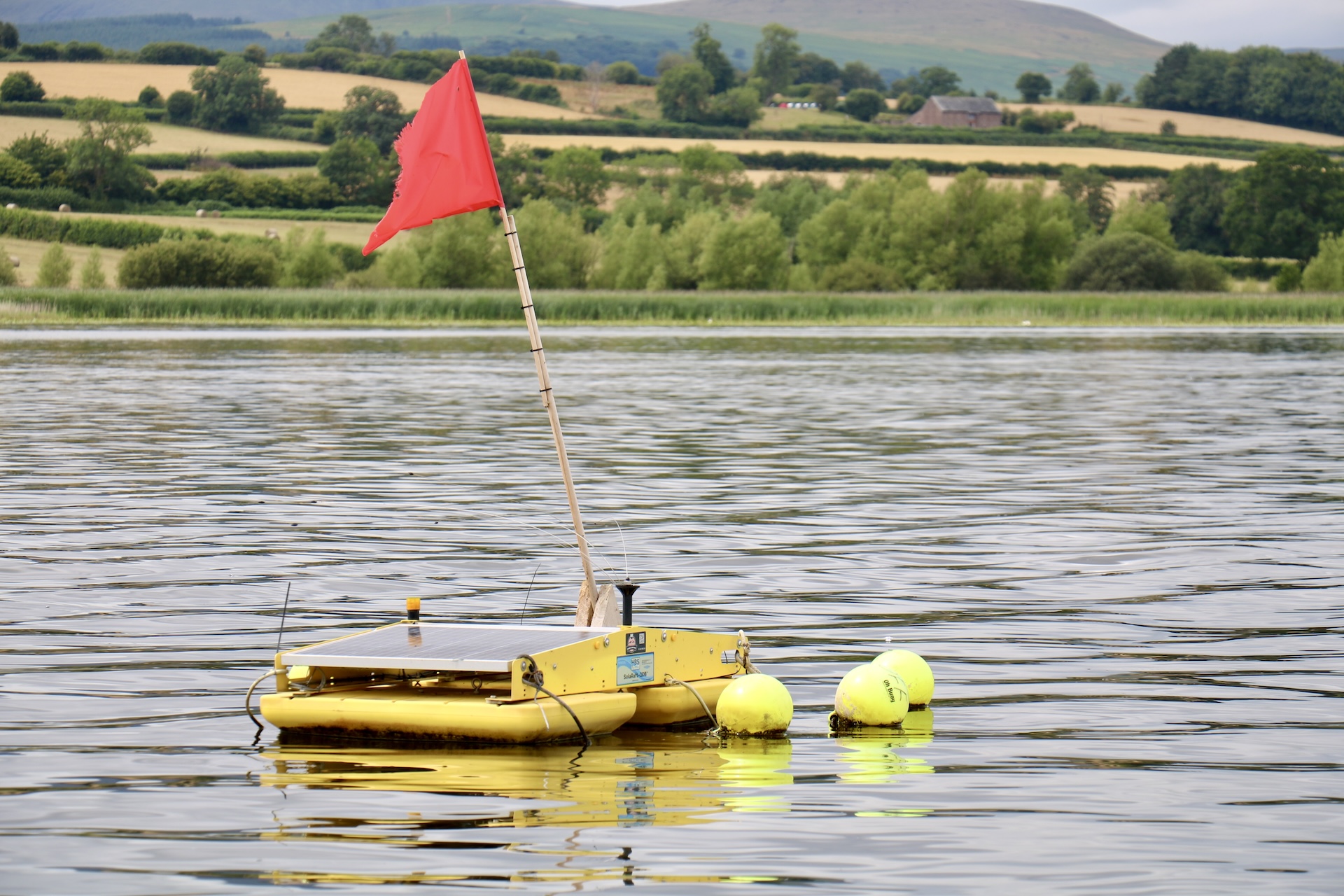
Last year a so-called “Unidentified Floating Object” appeared on the lake – it carries out “sonic cracking” of blue green algae – which sounds very sci-fi - and we hear it’s been a success.
In 2025, the “UFO” looked like a raft of equipment – approximately 2 metres square, with visible solar panels and a small mast with a warning red flag. This year it’ll be slightly bigger – and won’t have a flag. It can be clearly seen about 500m south-east of the entrance of the Club lagoon entrance to the wider lake – and we keep an eye open for it, and give it a wide berth, of course!
The facility is installed and managed by Garnet Davies. He runs Llangorse Caravan Park and the club’s neighbouring launch slipway for visiting boats, kayakers and paddleboarders. It’s also a boat-hire business – a family business that has operated on and by the lake for several generations. Arguably, it’s his family’s livelihood which is worst affected if, and when the lake is sufficiently affected by blue green algae (BGA) that human water-born activity is suspended. The facility was purchased jointly by this business and Llangorse Lake Conservation and Management Company Ltd – the lake’s private owner.
In recent years there’s been several times when activity close to the water has been stopped on health and safety grounds, by the Welsh Government’s environment management agency, Natural Resources Wales, (NRW). Garnet’s work in monitoring and now managing BGA – is reported to the Llangorse Lake Advisory Group (LLAG). This is a body made up of lake users and immediate neighbours who have an interest in the health of the lake. The Club’s represented there: we’ve fed-in information we’ve gathered, and we assist in managing the lake too.
So, what is BGA and why is it a problem?
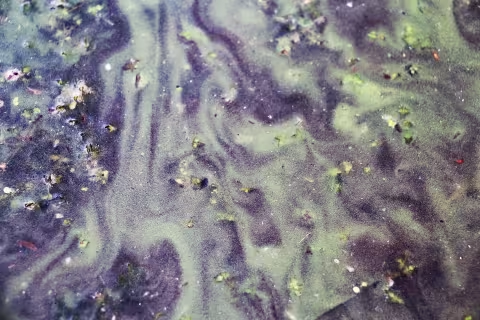
Blue green algae on the surface of still fresh water
Also known as cyanobacteria, they exist in all natural waterbodies. Algae are aquatic, photosynthetic organisms but they’re not quite plants because they don’t have true roots, stems, leaves and embryos. What they do have is distinct cells bound by a membrane which contain a nucleus and other structures enabling them to produce energy and reproduce. Algae can cause various human health hazards: skin rashes, tummy upsets, breathing difficulty and allergic reactions.
In other parts of the world, notably in hot countries where other aquatic nutrient problems make the problem worse, algal growth isn’t restricted to summer months – and hot-weather blooms occur at a much greater scale. China’s Lake Taihu – the country’s third largest inland waterbody at over 2,000km² – has taken-on a green hue across the whole lake. A vital source of drinking water for millions, the issue has been – and remains – a real crisis. In South East Asia BGA’s been associated with liver damage and even tumour growth – but not (so far) in Europe. So, there’s good reason to understand how to manage algal bloom.
Here, BGA is more hazardous to dogs than to us. The British Veterinary Association has reported an uplift in cases since 2019 – especially last year. In the natural biological environment, the volume of algae can cause problems for aquatic and semi-aquatic animals. Even in the UK, in recent years, algal blooms have been photographed, appearing like spectral blue-green blankets covering water like a resplendent funeral shroud.
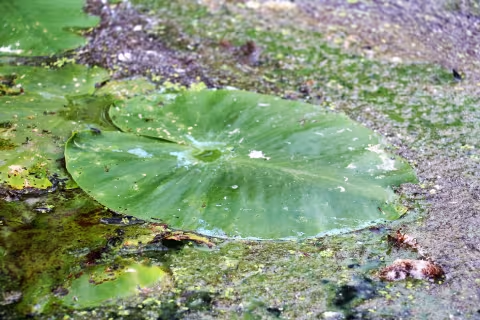
Our lake is often referred-to as “eutrophic”, meaning that it’s vulnerable to the increase of chemical nutrients in the ecosystem, causing blooms of algae and aquatic plants. Algae are most visible in relatively undisturbed, warmer water. On our site it can be seen in summer in still areas in the east creek and alongside jetties. Where water is occasionally washed onto lily-pads and it dries there, a deposit like a bright green powder can be seen. It’s pretty harmless to us in this state – and thankfully – the open water of the lake is normally too disturbed and cool enough not to be a problem for sailing – but we do issue guidance about avoiding capsize and washing body and kit very well.
When the ecosystem can’t support the growth anymore, we get decomposition of BGA by bacteria which consumes oxygen in the water – killing-off oxygen dependent organisms. Some water bodies are intensely affected: Lough Neagh and Lough Erne (Northern Ireland) and Windermere, for example. These are all waterbodies which are environmentally sensitive and, unlike most manmade reservoirs, intervention with chemicals is very difficult. The River Wye (into which Llangorse lake runs through the Llynfi), is often referred to as one of the UK’s most sensitive river catchments.
So, what’s “Sonic Cracking”, then?
What makes algae grow are temperature (warm) and light – both of which arrive at the water surface. Algae strands contain nitrogen-producing cells to help them float. Here’s the key: if the membranes of these cells can be broken – or cracked – the gas will be released and the strands will sink. At the lakebed illumination and temperature are both lower – so the algae stop multiplying. Another benefit is less toxin released into the water. The choice of ultrasonic frequency is very important in terms of effectiveness and the relationship between physical and chemical side effects. The Llangorse equipment cycles through a range of frequencies to “hit the right spot” to be most efficient.
An additional benefit of sonic cracking is that sunk algae are a form of carbon capture – so contributing to our efforts in tackling global warming.
In China, where waterbodies seem to be worst effected so-far, boats have been designed which carry sonic probes on each side – and one can imagine them moving slowly across lakes and reservoirs like combine harvesters in a wheat-field
The source-papers (see below) for this article poses questions about the physical mechanism of algal eradication, ie: how do algal cells break-down, and what’s left. Equally, little is known about long-term effects of algal cracking. At Llangorse, maybe we’re at the vanguard of freshwater habitat management innovation?
Is it working?
It seems so. Lab research has focused on variable ranges of ultrasound and its effect on various types of algae (one red one apparently thrives on sound like a teen in a nightclub) – and this has led to commercialisation. A quick dip via Google can reveal several companies specialising in a range of products. They’re sold under very reassuring messages: “No closing of the lake”, “No permits required”, and “Safe for humans and aquatic life.”
And, perhaps more importantly, our lake neighbour clearly feels this has been a success in keeping the lake BGA clear in a wide area. The year 2025 – wet April, long-hot summer - ought to have been a bad year for BGA – but it wasn’t. We didn’t experience intense water-weed problems either. Arguably, we saw the best sailing conditions on the lake we’ve seen for more than a generation. The cost of the equipment has increased significantly, so Garnet Davies says installation of a second unit will be delayed as he plans to build a bespoke frame and solar power unit for the second location.
Any side-effects?
The research papers assert that sonic control of BGA is safe in terms of the “mechanical index.” But they do urge caution with respect to the impact on aquatic and semi-aquatic animals. Hence the role of the LLAG – which includes NRW and some conservation groups – into which Garnet has regularly reported progress.
Garnet deserves the last words on the topic. Says he, “Fingers crossed that this year is as good as last!”
*This paper draws on the conclusions of:-
“Sonic cracking of blue-green algae” by Kotopoulis, Schommartz & Postema, Dept Engineering, University of Hull, 2009.
“The effects of ultrasound on cyanobacteria,” Wu, Joyce and Mason. University of Coventry, 2011.
And we’re grateful to Garnet Davies for his words, additional facts and his support for us in posting the article.
- Log in to post comments